


How can I get out of self-flagellation without losing my sense of responsibility?
There's a painful moment you know all too well: you finish a routine task, you mispronounce a word, or you fall behind on something, and then an inner voice starts judging you. It doesn't just say, "You could have done better." It whispers, "You're a failure, selfish, weak, and you'll never change." If you ask yourself: How do I get out of self-flagellation?The beginning is not in silencing this voice by force, but in understanding what it is trying to protect you from, and why it has chosen cruelty as its only language.
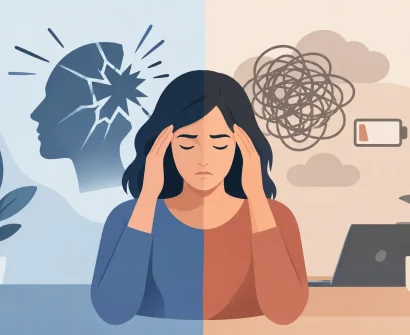
Self-flagellation doesn't make you more aware or more committed. Often, it leaves you stressed, paralyzed in the face of decision-making, or drained to the point You lose the ability to make real changes. Your life may seem organized from the outside – job, responsibilities, achievements – while inside you live under constant pressure that no one sees.
Self-flagellation is not a responsibility
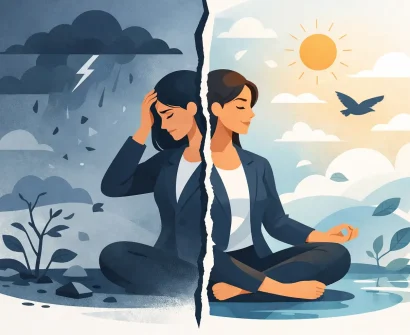
There is a crucial difference between taking responsibility and punishing yourself. Responsibility says, "I made a mistake, what was the impact, and what do I need to fix?" Self-flagellation, on the other hand, says, "I am entirely at fault." The former opens the door to maturity and improvement, while the latter conflates the action with your identity until you feel that nothing about you deserves mercy.
Perhaps you learned in childhood that acceptance is conditional on excellence, or that mistakes bring humiliation or emotional withdrawal. Perhaps criticism was the norm in your upbringing, or you grew up in an environment that stifled feelings and vulnerability. In such cases, your inner critic may become ingrained, not because you enjoy harshness, but because it has learned that constant pressure will prevent you from experiencing rejection, failure, or danger.
This doesn't mean justifying harmful behavior or shirking responsibility for its consequences. It simply means understanding that attacking oneself is neither the safest nor the most effective way to take responsibility. A person who is afraid of themselves doesn't change freely; they are simply trying to survive.
Why does the inner critic come back every time I try to move forward?
When you start setting boundaries, demanding your rights, or choosing what suits you instead of pleasing everyone, the criticism may become louder. You might be told you're selfish, ungrateful, or too far behind others. Not necessarily because these statements are true, but because a part of you fears that your freedom will lead to a loss of love or security.
From a trauma-conscious perspective, our responses don't arise in a vacuum. The body and mind retain old patterns formed when you lacked sufficient options. Therefore, your reaction to a minor mistake might be far greater than the actual situation warrants. You might experience chest tightness, facial flushing, insomnia, or a desire to disappear. Here, you don't need a lecture on positivity. You need enough security to observe what's happening without being overwhelmed by it.
Pay attention to the language you use with yourself.
The inner critic often speaks in absolute terms: always, forever, you're worthless, everyone is better than you. This isn't the language of balanced evaluation, but of threat. Ask yourself calmly: Does this statement describe a specific situation, or does it judge my entire existence?
Instead of saying, «I’m a failure because I didn’t accomplish anything today,» try this: «I’m exhausted today, and my delay is bothering me. What small, realistic step can I take?» This isn’t a linguistic trick. It’s a shift from attack to grounding in reality.
How can I practically overcome self-flagellation?
Don't expect a voice you've known for years to suddenly become pleasant overnight. The initial goal isn't to love everything about yourself, but to stop treating yourself like an enemy. Start the moment you notice the attack, not after you've finished your day and are exhausted.
Take a short pause. Place your feet on the ground and notice what's happening in your body. Are your shoulders tense? Is your breathing shallow? Is your stomach tight? Label the feeling without lengthy explanations: "There's fear," "There's shame," "There's anger at myself." Naming the experience helps you move from being completely absorbed by it to observing it.
Next, ask the critic a different question: «What are you afraid will happen if you stop being so harsh with me?» The answer might be: I’ll become lazy, I’ll fail, people will abandon me, or I’ll repeat an old mistake. Don’t argue with the answer right away. Acknowledge the fear first: «I understand you’re trying to protect me from failure.» Then add: «But I need a way of protecting me that doesn’t hurt me.».
This simple sentence resets your relationship with yourself. You don't banish the critical part of yourself, nor do you allow it to control your life. You see it, understand its intentions, and reclaim your position as an inner leader capable of choosing a more mature response.
Practice empathy without sugarcoating the truth.
Self-compassion doesn't mean saying everything you did was right. Sometimes we hurt someone, shirk responsibility, or repeat a pattern we know is harmful. True compassion is braver than denial in these situations because it allows you to face reality without falling apart.
You can say, «Yes, what I did was hurtful and had an impact. I’m ready to acknowledge it, apologize, and learn. But I won’t let this mistake become proof that I’m a bad person who doesn’t deserve a chance.» This is compassionate responsibility. It’s clear, it has boundaries, and it has dignity.
If you have someone you need to repair the relationship with, focus on the specific action and its specific impact. Apologize without making excuses, then ask what can help repair the damage, if possible. But be aware: repairing the relationship isn't always about restoring it, and you can't control the other person's reaction. Your responsibility is your honesty and your subsequent behavior, not forcing others to forgive you.
Change the environment that fuels self-flagellation
Some environments amplify your inner critic. Daily comparisons, relationships that use guilt to control, and work that ties your worth to constant productivity can all reopen old wounds. This doesn't mean you should abandon everything immediately—life is more complex than that—but it does mean you should acknowledge the impact clearly.
Be wary of those who make you feel you constantly have to prove yourself. Also, be wary of content that sells you the idea that comfort is weakness and that delay is the end of the road. You don't need more pressure to change. You need space to allow your nervous system to calm down, so that choice becomes possible.
It might help to write just three lines at the end of the day: What tired me out? What did I need but didn't ask for? And what small thing did I do for myself, even if it seemed insignificant? Don't turn writing into a new perfection project. The goal is to build an honest, observant relationship with yourself.
When do you need deeper support?
If self-criticism escalates into severe self-loathing, disrupts your sleep, relationships, and work, or leads you to self-harm or suicidal thoughts, don't bear this alone. Immediately contact a trusted individual, a mental health professional, or available emergency services in your country. Seeking support at this moment is not a sign of weakness, but a necessary form of protection.
You may also need professional support when you understand all these concepts theoretically, but your body still experiences overwhelming fear or shame. Knowledge alone doesn't always address the root cause. Working with a qualified and trauma-aware practitioner can help you understand the conflicting parts within you, release frozen responses, and build a sense of security that isn't based on perfection.
Healing doesn't begin when you stop making mistakes. It begins when you stop giving up on yourself every time you do. The next time that harsh voice rises, don't search for the perfect phrase to silence it. Stay close to yourself, take a breath, and say honestly, "I see my pain, and I will not add to it.".