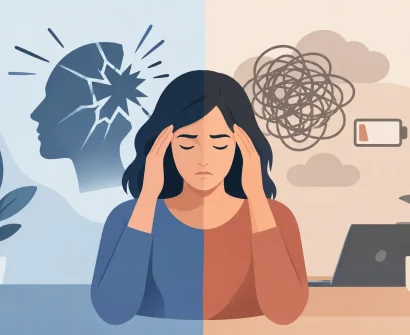




How can I regain my presence in the relationship without losing myself?
You might be sitting across from the person you love, hearing their voice and answering their questions, but a part of you is completely absent. You're observing yourself from within, afraid to say what you need to say, or rushing to apologize, or compromising so as not to lose their closeness. If you're asking: How do I regain my presence in the relationship?The question is not just how to become stronger in a debate, but how to return to yourself when you are close to another person.
Being present isn't about imposing your opinion, being available all the time, or becoming cold and unaffected. Being present is about being aware of what's happening within you and having enough space to choose before you agree, disagree, or withdraw. It's what makes a relationship a place to connect, not a place to disappear.
Why do we lose sight of ourselves within the relationship?
Many people interpret their absence as a sign of weakness. But what's often happening is much deeper. When they feel nervous system By threatening, even if the threat is just a tone of voice, a sudden silence, or the possibility of rejection, one may automatically switch to an old response: appeasing the other, freezing, withdrawing, defending, or controlling.
Perhaps you learned early on that love comes conditional on quietude, obedience, and fulfillment. Perhaps expressing anger or need was met with criticism or neglect. In that case, your current concessions are not always a conscious decision, but rather a clever attempt by your body to protect you from pain it has already experienced.
Therefore, don't start by questioning yourself: Why am I doing this? Start more gently: What part of me is trying to protect me from right now? This question shifts the relationship with the self from blame to understanding, and from reaction to the possibility of choice.
How can I regain my presence in the relationship from within first?
Reclaiming presence doesn't usually begin with a firm statement to your partner. It begins with the moment you realize you've let yourself go. This might manifest as a tightness in your chest, a feeling of heaviness in your throat, rapid speech, a desire to end the conversation, or a void where you don't know what to say.
Instead of ignoring these signals, pause for a few seconds. Place your feet on the ground, exhale slightly, and then name what's happening without exaggeration: I'm nervous right now. I feel like I want to agree even though I'm not convinced. I'm afraid of upsetting him/her. Simply naming things brings a piece of awareness back into the moment and lessens the power of the automatic response.
This doesn't mean you have to analyze every feeling during an argument. Sometimes, simply saying, "I need a minute to process what I'm feeling before I continue," is enough. A mature partner might not always like to pause, but they can respect that. If even a simple request for space is met with ridicule or punishment, that's a significant indicator of the relationship's security, not proof that you're overly sensitive.
Distinguish between closeness and merging
Healthy intimacy allows you to love and disagree at the same time. Dissolving into the other person's feelings and needs, however, occurs when your emotions and needs become dependent on their mood. If their bad mood makes you cancel your day, or if their rejection of an idea makes you doubt your worth, you may have taken on a responsibility that isn't solely yours.
Ask yourself after every emotional situation: What am I feeling? What does the other person need? And what am I carrying on their behalf? These questions do not create a cold distance, but rather restore the natural boundaries between two people.
Start with what is genuine, not with what is ideal.
There's a temptation to reassert your presence through a major confrontation: opening all the files, demanding everything you've been denied, and setting your boundaries all at once. But such a sudden change can be exhausting for both you and the relationship, especially if you've been accustomed to silence for years. It's better to start with a small act of honesty that you can commit to.
Instead of saying, "You never understand me," try saying, "When the conversation continues like this, I find myself shutting down and needing a break." And instead of agreeing to a date that doesn't suit you, say, "I'd like to see you, but this time isn't convenient." This isn't a lengthy excuse or an attack; it's a clear and respectful presence.
Honesty doesn't always guarantee a comfortable response. The other person might be upset because the old dynamic in the relationship was based on your compromise. But their upset doesn't necessarily mean you're wrong. The deeper question is: Are you expressing your truth without being offensive, and are you allowing space for their truth without erasing yourself?
Boundaries that protect the relationship and do not punish the partner
Boundaries are not a threat or a test of love. They are a clarification of what you accept and what you don't, and what you will do when those boundaries are crossed. They are most powerful when they are simple and actionable.
You might say: "I can't continue this conversation while raising my voice; I'll return to it when things have calmed down." Or: "I don't want to discuss our private matters in front of others." Or: "I need some time to myself each week without it being interpreted as rejection." Every boundary requires responsibility: to enforce it calmly, not to use it for control or revenge.
Remember that boundaries alone don't make a relationship successful. If the other person is willing to learn, they open a new door to respect. But if they continue to insult, intimidate, isolate, or monitor, the issue goes beyond communication skills. In relationships characterized by violence, threats, or constant fear, safety and professional support are priorities before attempting to repair intimacy.
Don't ask dialogue for what the body needs.
You may understand your pattern well, and know that Your fear of rejection It's old, and then you find yourself crumbling at the first sign of disagreement. This doesn't mean your understanding has failed. Knowledge is essential, but it's not always enough when the body carries a long-standing memory of stress.
Mindful work with your body helps you notice the signals before they escalate into withdrawal or an outburst. Calm walking, regulated breathing, noticing areas of tension, gentle movement, and resting after a difficult discussion are not minor details. They are a way of training your nervous system to Proximity does not always mean danger..
In therapy or supportive sessions, it's possible to explore which parts of the body are compensatory, protective, or withdrawn, without treating them as enemies. Some trauma-sensitive approaches help build a more compassionate relationship with these parts, because what appears destructive may actually be an age-old attempt to stay safe.
A short exercise before any sensitive conversation
Before you bring up a painful subject, give yourself two minutes. Not to prepare a perfect speech, but to find your true voice.
- Ask yourself: What is the primary feeling I am experiencing right now? Choose one or two words, such as fear, sadness, anger, or disappointment.
- Notice what you really need: listening, an apology, time, clarity, respect, or a specific change in behavior.
- Tell yourself: I don't need to prove that my feelings are valid in order to express them respectfully.
- Formulate one clear request instead of summarizing all the wounds in one conversation.
You could start the conversation with something like, "I want to share something with you because the relationship matters to me, not because I want to blame you." This doesn't absolve the other person of responsibility, but it reduces the likelihood of the conversation turning into a defensive battle.
Observe what happens after your true self is revealed.
Reasserting your presence reveals the quality of the relationship as much as it repairs it. When you begin to express your needs, pay attention to recurring patterns: Are you listened to, even if there's disagreement? Can the problem be fixed? Do you return from the conversation feeling more expansive, or more fearful and withdrawn?
A secure relationship isn't without disagreements, but it doesn't mean you have to pay for honesty with humiliation or threats of abandonment. Your partner isn't obligated to agree to all your needs, but they are responsible for treating them with compassion.
Sometimes reasserting your presence is an invitation for the relationship to mature. Sometimes it reveals that you were trying alone to maintain a relationship that didn't give you enough human space. Both possibilities are painful, but the truth is less costly than continuing to be absent.
Don't wait until you're fearless to speak. True presence isn't the absence of fear, but rather telling yourself in moments of fear: I am here, and I won't abandon myself to maintain this closeness. From this tranquil point, love can become a choice, not a constant struggle for survival.