




The best daily stress-relieving tools without ignoring the root causes
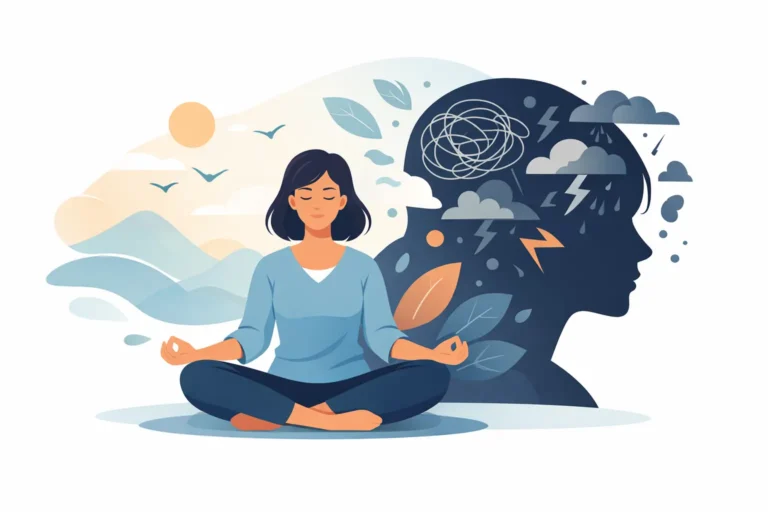
Your life may seem stable on the outside, while your body lives in a constant state of alert. You accomplish things, you smile, you reply to messages, then find yourself unable to sleep at night or lost in restless thoughts. That's when you become The best everyday stress-relieving tools It is not a luxury or a quick fix for silencing emotions, but a gentle way to tell your nervous system: You are not in danger right now.
But true calming doesn't mean forcing yourself to relax. Sometimes, through years of stress, trauma, or insecure relationships, the body has learned that vigilance is its survival mechanism. Therefore, we don't fight or shy away from your nervous response. We learn to listen to it and gradually build a safe space around it.
Why isn't the usual advice to "calm down" enough?
When the nervous system is on high alert, it doesn't always respond to logic. You might know something is simple, yet your heart races. You might be in a safe place, but your chest feels tight as if something bad is about to happen. This isn't a sign of weakness or a lack of faith or willpower. It's a protective mechanism that operates faster than conscious thought.
Therefore, we don't need to put more pressure on ourselves. We need frequent, small cues that help the body move from a defensive posture to greater regulation. Everyday tools don't address the root cause of the pain, but they give you a more stable foundation to understand what's happening inside you, instead of being swallowed up by the vortex.
The best daily stress-relieving tools start with the body.
Go to the location before you go to the problem.
When you feel anxious, don't immediately start analyzing the thought or blaming yourself. Slowly raise your gaze and look around at three neutral or comforting details: the color of the wall, the light from the window, the shape of a piece of furniture, or something stationary in the room. Let your eyes move gently, then notice where the chair or the floor supports you.
This practice is sometimes called visual orientation or exploration. Its value lies in reminding the nervous system of the present moment. You're not trying to convince yourself that everything is fine, but rather gathering sensory evidence that this moment is different from past moments of danger. One minute may be enough, especially before a stressful meeting or after a troubling phone call.
Exhale longer, don't force yourself to breathe.
Breathing is a useful tool, but it doesn't work the same way for everyone. Some people, especially those with a history of panic attacks or dissociation, may feel more anxious when asked to take deep breaths. A gentler alternative is to keep the inhalation to a minimum and allow the exhalation to last a little longer without straining.
Try inhaling naturally, then exhaling slowly as if you're cooling a hot drink. Repeat this four or five times, relaxing your jaw and shoulders. If you feel dizzy, tightness in your chest, or strong resistance, stop and go back to looking around or moving your feet. The goal isn't to perform the exercise correctly, but to make your body feel like it has a choice.
Pressure and containment: A tactile safety message
Place one hand on your chest and the other on your stomach, or wrap your arms around your shoulders with gentle, steady pressure. You can also lean against a wall and push against it with the palms of your hands for a few seconds. These simple movements give the body a tangible boundary, which is something many people need when they feel scattered, disconnected, or overwhelmed with emotion.
Tell yourself, in a realistic way, «I’m here. I feel stressed, but I don’t have to solve everything right now.» Don’t repeat a phrase you don’t believe. Honesty is more important than positivity. If «I’m completely safe» doesn’t reflect your experience, choose: «I’m looking for a little bit of safety in this moment.».
The movement that discharges the charge instead of suppressing it.
Not all stress requires sitting still. Sometimes anxiety is a defensive energy trapped in the body. After hours of calls, news, or trying to stay composed, your body may need slow, deliberate movement more than it needs more thinking.
Walk for five or ten minutes without your phone, and pay attention to the shift in weight between your feet. Or gently rock your arms and legs, then stop and notice what changes. You can also tense your muscles for a few seconds and then relax them, starting with your hands and moving up to your shoulders. The idea isn't to "get rid of" the feelings, but to allow your body to complete a part of a response that it hasn't had the space for.
In practices like TRE®, movement and muscle twitching are used deliberately to help release pent-up tension. But if intense emotions, confusing memories, or a feeling of losing control arise, don't push yourself to continue alone. Gradual progression and qualified support are part of the safer approach, not a hindrance.
Make clear transitions within your day
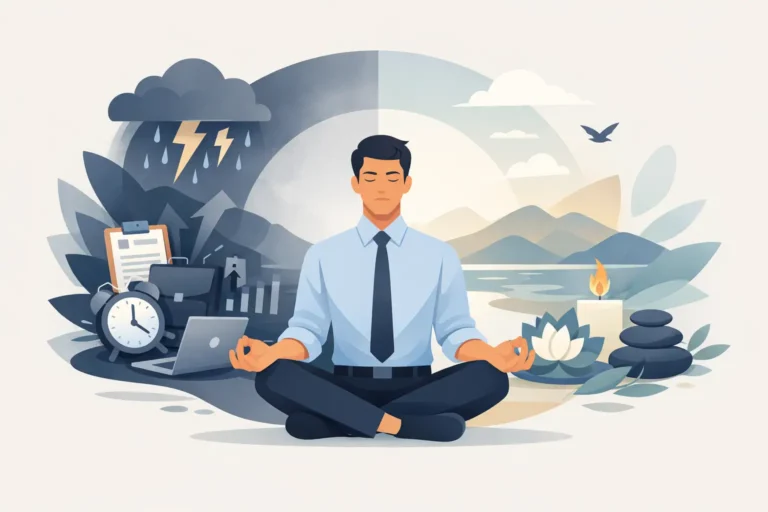
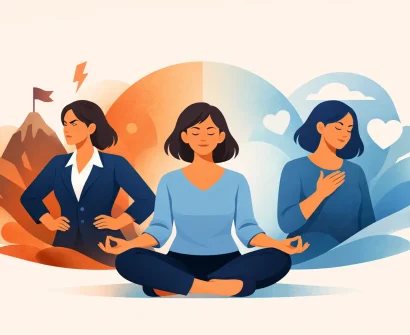
Much of the burnout doesn't come from a single task, but from constantly switching between conflicting roles: a pressured employee, a demanding partner, a son or daughter burdened with family responsibilities, and then someone trying to fall asleep before the day's effects have fully subsided. When we don't allow the nervous system a break between these roles, it remains in a state of perpetual activity.
Choose a short ritual to repeat at the end of the workday or before entering the house. It could be washing your face with lukewarm water, changing clothes, standing for two minutes by a window, or sitting in the car before getting in without looking at your phone. Don't underestimate these signals. Repetition tells the body that one chapter has ended and that it doesn't have to carry everything into the next.
In the evening, reduce screen time before bed. The problem isn't just the phone itself, but the stimulation it brings: work messages, comparisons, news, and conversations that demand immediate responses. If you can't eliminate it completely, set a small, clear limit: ten screen-free minutes before bed, replaced by soft lighting and paying attention to your body's needs.
From calming down to listening: What is your inner voice asking for?
Once the tension has subsided a bit, you can ask a different question than "How do I get rid of this?" Ask instead: "What part of me is afraid right now? And what is it trying to protect me from?" The question may seem simple, but it changes your relationship with yourself. Instead of dealing with Anxiety as an enemyYou begin to see it as a part that carries a function, even if its method is exhausting.
In the Internal Family Systems (IFS) approach, these parts are not seen as flaws to be eliminated, but rather as internal aspects that need understanding and compassionate guidance. There might be a part that pushes you toward perfection to avoid criticism, a part that withdraws to avoid pain, or a part that becomes angry because it's tired of being ignored. Daily calming creates the necessary space to hear these voices without them having to control your life.
After a moment of reflection, write just three lines: What do I feel in my body? What happened before? What do I need now? Don't turn writing into a harsh interrogation or a productive task. It's enough to be an honest witness to your experience.
When are everyday tools insufficient?
These practices are helpful, but they are not a substitute for professional support when pain becomes frequent or debilitating. If you are experiencing persistent nightmares, panic attacks, harmful impulses, severe numbness and dissociation, or thoughts of self-harm, your priority should be to contact a mental health professional or a trusted local emergency services.
Likewise, if you feel that every attempt to calm down opens a door to painful memories, it doesn't necessarily mean you've failed. It might mean that Your nervous system He needs a supportive and trauma-sensitive approach that works at your pace. Deep work, whether through compassionate inquiry, physical approaches, or qualified psychotherapy, doesn't just manage symptoms. It helps you understand the root cause that made the mobilization so familiar in the first place.
Choose one tool and give it a chance.
You don't need a perfect ten-step routine. Start with one tool that feels possible today: a minute of mindfulness, a gentler exhale, a short walk without your phone, or a hand on your heart with a heartfelt affirmation. Practice it during a relatively calm time, not just when you're at your breaking point, because the body learns more from repetition than from emergency fixes.
Perhaps the kindest gift you can give yourself is to stop demanding a quick recovery. Your body didn't become ready overnight, and it won't need harsh treatment to regain its balance. Every small moment of presence tells it: I see you, and I'm staying with you.



How can I regain my presence in the relationship without losing myself? – montasirmusa.com
[…] in the personality. But what often happens is deeper than that. When the nervous system senses a threat, even if the threat is just a tone of voice or silence […]