




Why does an inner emptiness appear after success despite achievement?
You might reach the position you've strived for for years, complete a major project, buy what you've always dreamed of, or hear the words of praise you've long awaited. Then you return home, the noise subsides, and a heavy question lingers within you: Why do I feel nothing?
The inner void after success This is a more common experience than it seems, especially for those who have learned that their worth comes from their accomplishments. This doesn't mean you're ungrateful, nor does it mean you should tear down what you've built. It might simply mean that a deep part of you has been on hold all along the way, and now it's asking to be seen.
Success fulfills goals, not always emotional needs.
External success can solve real problems. It grants independence, broader options, professional recognition, and may alleviate significant financial or social pressure. But there are needs that no title or bank account number can guarantee: inner security, unconditional acceptance, bodily comfort, a sense of belonging, and the ability to be yourself without constant performance.
When achievement becomes the only path to feeling fulfilled, it transforms into a never-ending task. You reach your goal, experience a brief sense of satisfaction, and then your mind immediately begins searching for the next one. This isn't necessarily because you're ambitious, but because your internal system has long since learned that stopping is not safe.
Perhaps you grew up in an environment where love was tied to superiority, or where making a mistake could cost you criticism or emotional withdrawal. Perhaps you had experiences that made you feel you had to prove yourself in every room you entered. Here, work is no longer just work. It becomes a form of protection, a silent attempt to avoid a more ingrained feeling of pain, inadequacy, or unworthiness.
Why does inner emptiness appear after success?
Because success can remove the distractions that kept you busy. While striving, you have a to-do list, deadlines, pressure, and expectations. But after achieving it, feelings that you previously had no time or space to experience may surface.
You might experience sadness for no apparent reason. Anxiety might creep in during moments of peace. You might feel that what you've achieved doesn't quite reflect who you are, even though it seems right to everyone else. This isn't necessarily a sign that your decision was wrong. Sometimes it's a sign that one part of you made the decision under pressure to survive, while another part now needs a voice and space.
There's also what might be called "lost identity after the goal." If you've defined yourself for years as someone who strives, endures, and doesn't give up, who are you when the battle is over? Some people feel confused because they haven't learned how to live without the stress that pushes them forward.
Do not interpret the feeling as a moral failure.
The worst thing you can do to yourself is add guilt to the pain. You tell yourself: I have what others desire, so I have no right to suffer. Or: I must be happy now, otherwise I am ungrateful.
Gratitude doesn't eliminate suffering. You can be grateful for what you've achieved and still feel sadness, detachment, or exhaustion. The psyche doesn't operate on comparison. The fact that someone is facing more difficult circumstances doesn't make your own wounds any less in need of attention.
It's important to distinguish between a temporary lull after an intense period and a persistent pattern that accompanies you despite changing circumstances. If the burnout continues, affects your sleep, relationships, and work performance, or is accompanied by intense despair, seeking professional support is not an exaggeration. It's a mature form of self-care.
What is the void trying to tell you?
Instead of asking: How do I get rid of this feeling quickly? Try asking: What did I not allow myself to feel while I was busy arriving?
The answer might be years of accumulated fatigue. It might be anger at a life structured to meet the expectations of others. It might be sadness over a childhood that needed nurturing but received unsolicited advice, or over a relationship where you were physically present but emotionally absent due to pressure. Or it might be a simple yet profound need: to love yourself when you're not producing anything.
These questions aren't answered in a single meditation session. Some answers manifest in the body before words: a tightness in the chest when talking about work, tension when relaxing, or a sudden urge to cry when someone compliments you. The body isn't exaggerating, but it may convey messages the mind hasn't had time to process.
Pay attention to quick escape solutions
When emptiness becomes painful, it's natural to seek something to fill the void. This might be a new project, longer working hours, frequent purchases, fast-paced relationships, or constant consumption of content. The problem isn't work or pleasure itself, but rather the question: Do I choose this freely, or do I use it to avoid being alone with myself?
Escape provides temporary reliefBut it often brings you back to the same point with even more exhaustion. A calm approach to the feeling, on the other hand, gives you a chance to understand its root cause, and that's the difference between relief and recovery.
A more honest process begins
You don't need to make life-altering decisions when you're at your most confused. Don't quit your job abruptly just because you don't feel fulfilled, and don't force yourself to continue in the same way because others see you as successful. Start with small steps that help you reconnect with yourself.
Set aside regular time to ask yourself, "What have I accomplished?" Instead, ask yourself, "How do I feel?" Write frankly about the moment success began to feel heavy, and about the price you paid in terms of your health, your relationships, or your ability to rest. Don't look for a clever answer. Look for an honest one.
Also, pay attention to your inner voice when you make a mistake or stop. Does it speak harshly to you? Does it say your worth will diminish if you remain silent? This voice is often not your whole truth, but rather an old strategy developed to protect you. Approaching it with curiosity and compassion, not with resistance, opens a different door to change.
In trauma-conscious therapy, we don't simply change positive thoughts or boost motivation. We go to the root causes: the parts of the body that harbor fear, the bodily responses that still act as if danger is present, and the relationship patterns that make it difficult to seek support. Techniques such as compassionate inquiry, IFS, TRE®, and NARM® can help some people gradually build inner safety. But the right approach depends on your story, your readiness, and having qualified support that respects your pace.
Success that doesn't require you to disappear
Healing doesn't mean abandoning your ambition or viewing success as something superficial. Ambition can be beautiful and creative when it's not driven by panic. The difference is achieving because you want to express your abilities, not because you're afraid of being worthless if you stop.
You may discover that some of your goals are still important, but you'll pursue them in a less intense way. You may also find that your definition of success needs to broaden: more restful sleep, more genuine relationships, clearer boundaries, the ability to enjoy the ordinary moment, and time when you don't have to prove anything to anyone.
Emptiness isn't always an enemy to be silenced. Sometimes it's the first space where you can hear yourself after years of noise. Don't rush to fill it. Sit gently beside it, take its message to heart, for it may be the beginning of a life where you don't need success to feel you deserve peace.
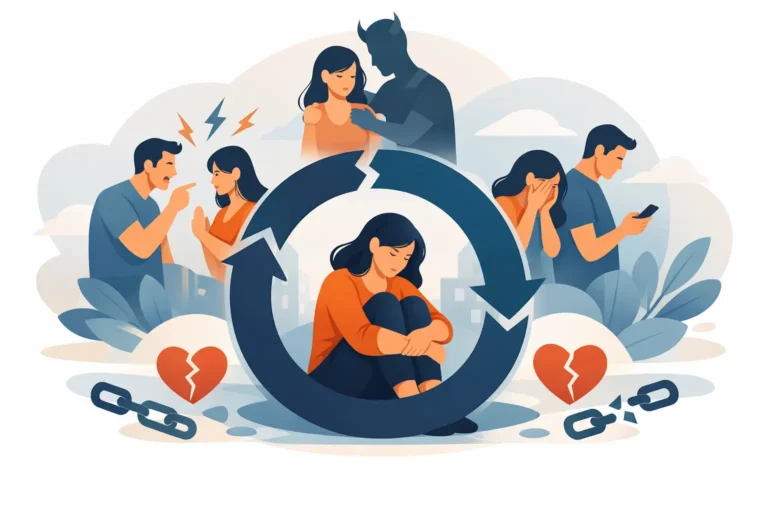







How do I deal with inner conflict without losing myself? – montasirmusa.com
[…] Inner disconnection is a feeling of being divided or alienated from oneself. You may know exactly what you should do, but feel no real ability to do it. You may love someone, then find yourself cold or defensive when they get close. You may be professionally successful, while inside you there remains an emptiness that achievements cannot fill. […]