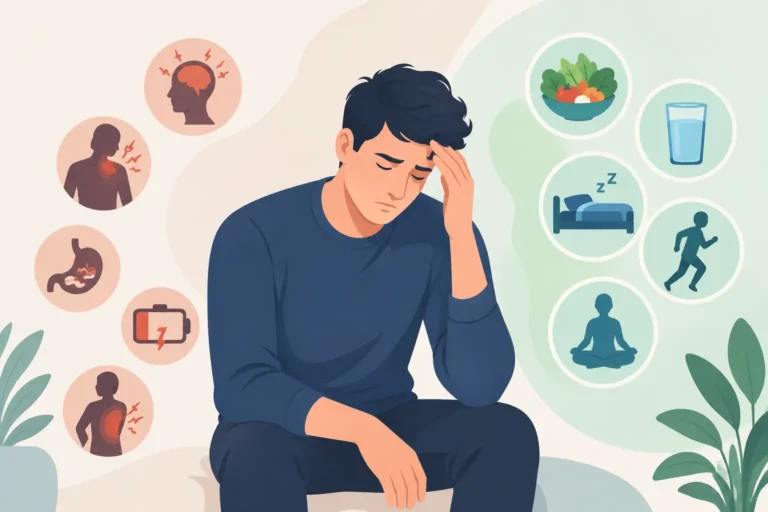




Improving relationships through emotional healing begins from within.
The problem in the relationship might seem obvious: recurring arguments, sudden coldness, sensitivity to casual remarks, or the painful feeling that you give a lot and go unnoticed. But Improving relationships through emotional healing It begins when we stop asking: How do I make the other person change? And start asking a more honest question: What happens inside me when I feel rejected, ignored, or insecure?
Not every conflict between two people is proof that love is over. Sometimes, a conflict is a moment when the body and nervous system reveal wounds older than the relationship itself. Your strong reaction to a delayed message or your partner's withdrawal during an argument might be linked to a past experience where you learned that closeness isn't guaranteed and that your needs might not be met.
Why don't superficial tips always work?
You might hear advice like: communicate more, be positive, don't go to bed angry. While this can be helpful in some situations, it doesn't address the root cause if one of you enters the argument defensively, frozen, or in a state of panic. The person who feels threatened doesn't primarily need a better argument, but rather a sense of security that allows them to remain present.
When it is overburdened nervous systemOrdinary conversation becomes difficult. A neutral tone might be interpreted as an attack, you might withdraw because you can't find the words, or you might raise your voice because a part of you fears not being heard. These aren't justifications for hurting others, but they are important explanations. The difference between justifying and healing is that healing makes you responsible for the impact of your own hurt, rather than making your partner pay for it.
A relationship cannot be repaired by communication skills alone if fear is driving the communication. Therefore, deep emotional work not only teaches you what to say, but also helps you identify who is speaking within you when a conflict arises: Is it the conscious adult within you, or a small part afraid of abandonment?
Improving relationships through emotional healing does not mean self-blame.
A common misconception is that if the solution begins from within, it means the entire problem lies with one person. This isn't true. A relationship might be strained by a lack of respect, lies, infidelity, manipulation, or a significant disparity in willingness to take responsibility. In these cases, healing isn't about enduring what hurts you, but rather about seeing reality clearly and setting boundaries that protect your dignity.
Emotional healing doesn't tell you to stay no matter what. Nor does it tell you to forgive before you acknowledge the pain. It gives you the space to calmly ask: Is this relationship safe enough? Is there a genuine desire on both sides to repair things? Do I have to compromise myself so as not to lose the connection?
Sometimes improving a relationship means regaining the ability to connect without losing oneself. Sometimes it means being able to distance oneself without resentment. It depends on the nature of the relationship and the presence of mutual security and responsibility, not just the degree of attachment.
How does emotional hurt manifest itself within a relationship?
The hurt doesn't enter a relationship wearing its real name. It rarely says, "I'm afraid of being abandoned." Instead, it might manifest as surveillance, jealousy, constant testing of love, criticism, or prolonged silence. The person might say, "I don't care," while their body tenses and their heart awaits a single sign that they are still loved.
The wound of rejection may manifest as a constant need for reassurance. The wound of neglect may appear in choosing emotionally distant partners, because this pattern is familiar despite its pain. The wound of control may manifest as difficulty asking for help or acknowledging a need. What is familiar to the nervous system may feel safer than something healthy we have never experienced before.
This is where the value of approaches comes in. Conscious of psychological trauma. In compassionate inquiry-based work, stress response regulation, and understanding the inner workings, we don't treat the reaction as a character flaw. We see it as an old response that was trying to protect you. Then, along with it, we learn a new, more compassionate and mindful way of being present in the relationship.
Start before the moment of explosion
Don't wait for the next conflict to practice mindfulness. When you're calm, observe your emotional map in relationships. What situations make you feel withdrawn? What words trigger anger within you? How do you know when you're starting to disconnect from yourself or from others?
You can start with a simple exercise: when you're affected, name what's happening before you try to explain it. Tell yourself: I'm feeling scared, lonely, or humiliated right now. Then notice where it manifests in your body: is there a tightness in your chest, a heaviness in your stomach, tension in your jaw? This little pause doesn't solve everything, but it separates the feeling from the automatic reaction.
Then ask yourself: What do I really need? Perhaps you need a little time to calm down, or for clarification, or for containment, or for boundaries. A clear need can be expressed. Accusation, on the other hand, often puts the other person on the defensive.
Instead of saying, "You never care about me," you could say, "When communication suddenly stops, I get anxious, and I need you to let me know if you're busy so I don't fill the silence with hurtful assumptions." This doesn't guarantee the other person will respond the way you want, but it gives the relationship a chance for a more honest and less damaging conversation.
Reconciliation after a dispute is more important than perfection.
Healthy relationships aren't relationships without hurt feelings or misunderstandings. They're relationships where both parties know how to mend fences after a break. Repairing a relationship can begin with a simple admission: I was stressed and raised my voice, and that wasn't acceptable. I want to understand what happened and apologize for the hurt I caused.
A true apology doesn't demand that the other person quickly get over their hurt. Nor does it add a phrase like, "But you started it." It acknowledges the impact, takes responsibility, and commits to tangible change. In contrast, making amends doesn't mean abandoning your truth to restore calm. You can apologize for the manner in which you spoke, while still retaining your right to address the need or the boundary that was crossed.
If the same issue keeps resurfacing, don't just discuss the last incident. Ask yourselves: What cycle are we caught in? Perhaps one of you seeks closeness when you're afraid, while the other withdraws when they feel pressured. Each of you perceives the other's behavior as a threat, and the cycle feeds on itself. Labeling the cycle transforms the problem into something you can both confront together, rather than one of you becoming the problem.
Borders are neither punishment nor walls.
Many people confuse love with complete availability. They accept what burdens them, then explode later. A healthy boundary isn't a threat, but a clear statement of what you need to remain in a relationship with honesty and respect.
The limit might be pausing the discussion when it turns insulting, then returning to it after things have calmed down. It might be refusing to let your phone be monitored to prove your loyalty. It might be saying you need time and space, without using silence as a way to punish the other person.
Boundaries may be unsettling for those accustomed to unrestricted access to every part of you. This doesn't make them wrong. But how you present them matters: be clear, specific, and consistent. Don't use boundaries to control others, but to define what you will do to protect your peace.
When does a relationship need deeper support?
If disagreements are repeatedly triggering anxiety, insomnia, numbness, or an intense fear of abandonment, it may not simply be a communication problem. If every honest conversation devolves into a meltdown, withdrawal, or blame, having a supportive space that is conscious of trauma can help you both understand what you can't see on your own.
Working alone is beneficial even when a partner doesn't want to participate. Because when you learn Organize yourselfBy understanding your inner self, reclaiming your voice and boundaries, your position within the relationship shifts. However, one-on-one support alone won't transform an insecure relationship into a healthy one. Shared responsibility remains essential when the goal is to build lasting intimacy.
In the spaces of deep work, we don't look for a guilty person. We look for the root: Where did you learn that love is conditional? When did silence become dangerous? And why does asking for a simple need seem like a huge risk? These kinds of questions require patience and compassion, not haste or ready-made solutions.
You don't need to become a perfect version of yourself to deserve a peaceful relationship. You just need to be honest enough to see what you're carrying, and brave enough not to pass it on to the one you love. Every time you choose to pause, breathe, and clearly express your needs, you're not only protecting your relationship, but you're also building a new sense of security within yourself.