


A guide to overcoming emotional repression without denying your pain
Your life may appear stable from the outside: work completed, responsibilities managed, relationships sustained, and a smile that appears at the right time. But in a moment of calm, you might feel an unnamed unease, a sudden urge to cry, or anger seeping into the smallest details. A guide to overcoming emotional repression It doesn't begin with asking you to become more positive, but with a more honest question: What did you have to hide in order to feel safe, accepted, or in control?
Emotional repression is not a character flaw, nor is it evidence of weak faith or immaturity. Often, it is an intelligent response learned early on by the nervous system. When feelings were unwelcome, or when expressing them would result in criticism, punishment, or withdrawal, silence became a means of survival. The problem isn't that this mechanism existed, but rather its persistence after the need for it has passed.
What is emotional repression really?
Repression isn't simply about not crying or avoiding talking about problems. It's a gradual separation between what's happening inside you and what you allow yourself to acknowledge, feel, or show. You might know logically that you're exhausted, but you don't stop. You might know that a relationship is hurting you, but you keep justifying it. You might get angry when your boundaries are pushed, then quickly say, "It's okay, it's not worth it.".
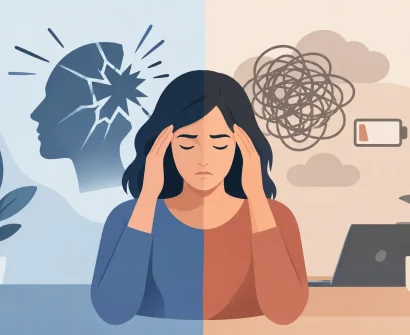
Feelings that don't find a safe space don't disappear. They often change their language. They might manifest as insomnia, chest tightness, irritability, impulsive eating, social withdrawal, or a constant need to be busy. Therefore, it's not enough to ask, "Why am I tense?" Sometimes the more accurate question is, "Which feeling haven't I allowed to be fully processed?"«
Why does a competent person succeed in hiding their pain?
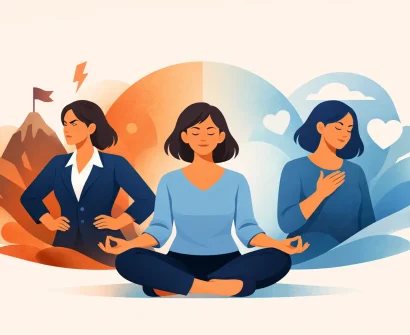
High performers are adept at turning pain into achievement. They accomplish more, take on greater responsibilities, and appear resilient in crises. These abilities are real and important, but they can become a smokescreen when they become the only way to feel valued or secure.
It can be difficult for a competent person to admit they need support because they are used to being the one providing it. They may fear that opening up to their emotions will cause them to break down or lose control. But feeling is not a breakdown. Emotions are energy, information, and an internal movement that needs to be acknowledged and embraced, not judged or denied.
Signs that say you don't need any more endurance
There's no single sign that proves emotional repression, and the symptoms can be linked to various stressors or health conditions. But the recurrence of these patterns warrants attention: feeling numb instead of sad, laughing when you're hurt, or apologizing for your needs before you even voice them. You might find it difficult to identify what you're feeling and resort to phrases like "It's normal," "I don't know," and "Everyone goes through this.".
Other signs include feeling tense while insisting everything is fine, or finally snapping after a long period of patience over a minor issue. Sometimes, repressed emotions in relationships manifest as excessive pleasing others, fear of conflict, or cold withdrawal instead of saying, "This hurts.".
The point is not to search yourself for a problem. The point is to see the pattern without blame. When you see what's happening clearly, you have a new choice.
A guide to overcoming emotional repression: Start with security, not catharsis.
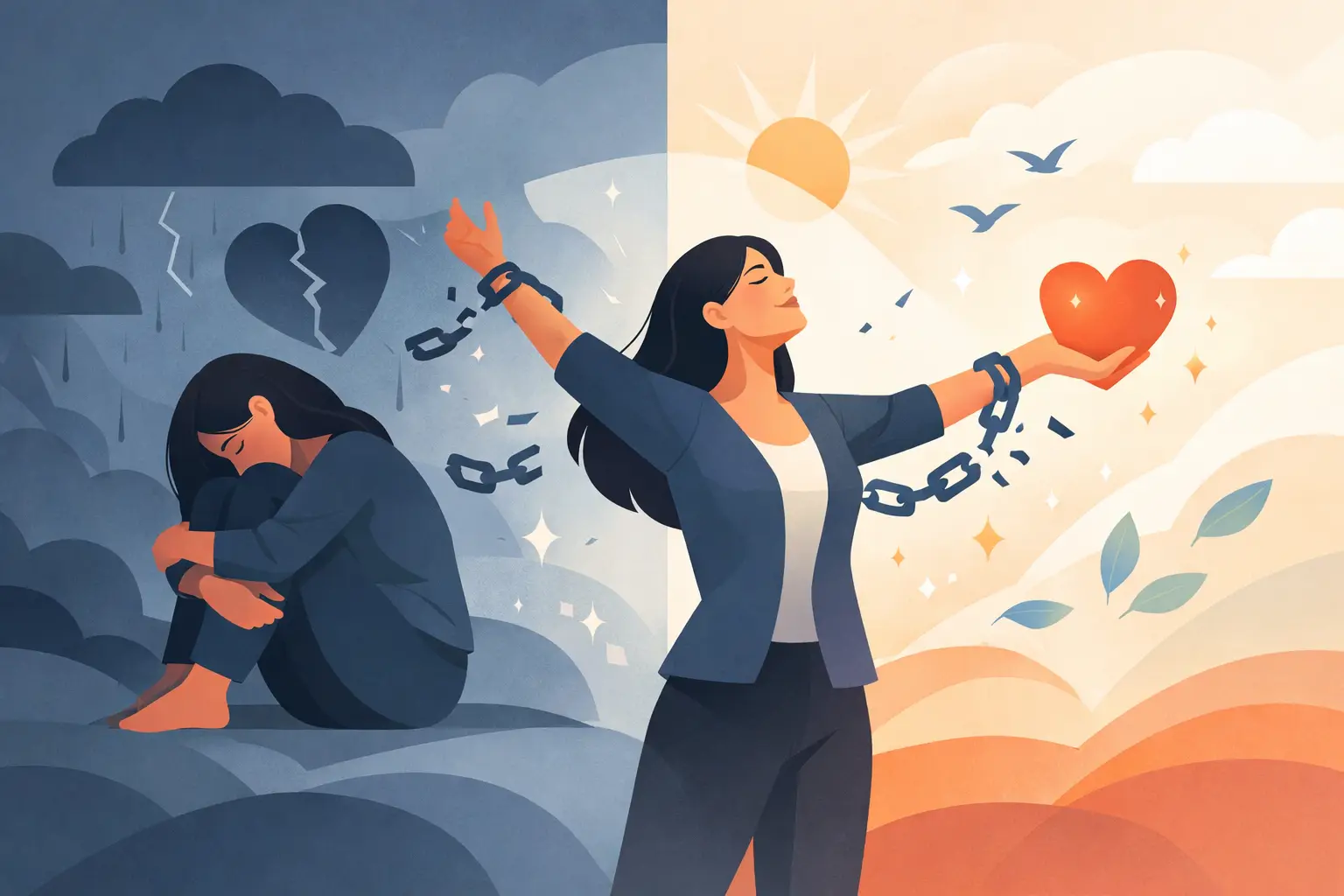
A common misconception is that healing means letting everything out at once. This isn't for everyone and can be especially overwhelming for those who have experienced difficult situations or live with high anxiety. True liberation isn't about drowning in memories or emotions, but about expanding your capacity to stay close to yourself without losing your balance.
Label what you're feeling as a tolerable degree.
Instead of asking, "What's wrong with me?", try asking, "How am I feeling right now, even if it's just 10 percent?" The answer might not be obvious sadness. It could be a feeling of unease, heaviness, disappointment, fear of failure, or exhaustion from always having to be strong.
You don't need a perfect description. It's enough to put a few words in the air to describe what's happening. Naming the feeling doesn't eliminate it, but it reduces the ambiguity surrounding it. And it's ambiguity that sometimes makes a feeling seem more dangerous than it actually is.
Pay attention to the body before the story.
The mind loves to explain and analyze, but the body often picks up on what hasn't been said. When you feel a sensation, notice where it's located: Is it in your throat? Your chest? Your stomach? Your shoulders? Don't try to force it away. Just take a calm breath, look around to remind yourself that you're in the present moment, and then notice the sensation for twenty or thirty seconds.
If the discomfort intensifies, return to something supportive: your feet on the floor, the feel of your chair, the sound of the air conditioner, or a glass of cold water. These aren't tricks to ignore the feeling, but rather signals to your nervous system that you can approach the experience without being alone in it.
Distinguish between feeling and action
Feeling angry doesn't mean you should hurt someone. Feeling sad doesn't mean you should give up. Acknowledging jealousy or fear doesn't define you. Repression often confuses feeling with behavior, leading you to suppress the feeling for fear of acting.
Give yourself this statement: «I am allowed to feel, and I am responsible for my choices.» It contains space for honesty and boundaries that protect you and others.
Start with a small, sincere expression
It doesn't have to start with a big confrontation with family or a partner. The first expression might be writing a letter you don't send, saying "I need time to think" instead of automatically agreeing, or sharing a single sentence with a trusted person: "I'm going through a tough time and I don't want to sum it up with the word 'normal'.".
Healthy self-expression isn't about endless venting or demanding that others fix you. It's about sharing an inner truth in an appropriate amount, in an appropriate place, with someone who can receive it. Sometimes writing, quiet movement, or even private crying is enough to start. Sometimes you need a clear conversation and new boundaries. It depends on the level of security in the relationship and your current ability to regulate.
When feelings are linked to an older wound
Some feelings aren't just about the present situation. A simple criticism might awaken an old feeling of inadequacy, a delayed response might trigger a fear of abandonment, or asking for help might feel humiliating. Here, it's not just about convincing yourself that the past is over. It's about understanding that a part of you is still trying to protect you in the way it knew how.
Trauma-conscious approaches, such as compassionate inquiry, IFS, NARM, and body organizing through practices like TRE®, do not treat these responses as enemies. They view them as protective mechanisms or patterns with a cause and a history. This perspective shifts the language from "Why did I mess everything up?" to "What is this part trying to keep from me?".
This doesn't mean all pain stems from trauma, nor that you need to search for a dramatic memory to deserve support. Patterns of repression can form from simple repetitions: comparison, criticism, not listening, pressure to achieve, or the absence of a safe space for emotions. The impact is determined by what your nervous system has experienced, not by what seems big or small to others.
Mistakes that delay liberation
The first step is to transform awareness into a performance project. You might read extensively about attachment, trauma, and boundaries, then use that knowledge to critically examine yourself more accurately. Understanding is helpful, but it doesn't replace repeated, safe experience.
The second mistake is forcing yourself to forgive or be grateful too quickly. Gratitude is a beautiful quality, but it shouldn't be used to suppress anger or sadness. You can be grateful for things in your life while still acknowledging that something has hurt you.
The third mistake is believing that independence means doing everything alone. Some doors open when a structured and trustworthy person is present, someone who can stay with you without judgment or pressure. Asking for support is not a surrender of your power, but rather an exercise in a deeper form of self-leadership.
When do you need expert support?
If your feelings are leading to recurrent panic attacks, intrusive memories, an inability to function or sleep, or thoughts of self-harm, professional support is not a luxury. Contact a licensed mental health professional or emergency services in your country immediately if you are in immediate danger. Deep emotional work sometimes requires a clear therapeutic framework, especially when past experiences are strongly present in your body and daily life.
In trauma-conscious training spaces, such as the work offered by Montasir Musa, the value lies in not being driven to harsh confession or violent recall, but rather being accompanied in building security and internal communication step by step.
It's not your job to bring out everything you've been holding back tonight. Your immediate task is to stop abandoning yourself when a difficult feeling arises. Take a moment, place your hand on your chest if it's comfortable, and sincerely say, "I hear you now." This small sentence could be the beginning of a new relationship with yourself.