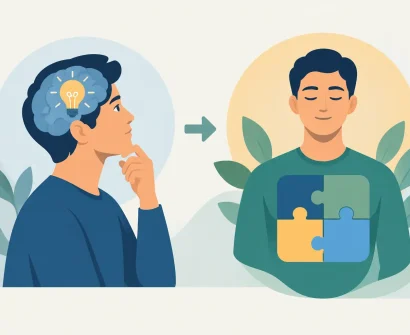




Deep coaching or motivation: Which one will change you?
You might finish a motivational video feeling like you can change your entire life before the weekend ends. Then the anxiety returns at night, the hesitation returns at the first decision, and that old refrain comes crawling back inside: "I know what I should do, but I can't seem to keep going." That's when the question becomes... Deep coaching or motivation? A sincere question, not just a comparison between two styles.
Motivation isn't the problem. It can awaken a long-needed hope, give you the energy to start a long-postponed conversation, cultivate a healthy habit, or take a career step. But when what's holding you back runs deeper than a lack of enthusiasm, simply yelling at yourself won't get you moving. You might need to understand why success becomes stressful, why you feel fear when you get close to what you want, and why painful relationships or decisions keep recurring despite your awareness of them.
What does motivation actually give you?
Motivation often focuses on action: set your goal, raise your standards, commit, don't give up. These messages can be helpful when the problem is clear and specific. If you know what you want, feel confident enough to pursue it, and only need organization or a short push, motivation can work well.
Let's say you want to return to sports after a break. Perhaps a simple challenge, a committed partner, or a clear reminder of the benefits will help. In this case, there's not necessarily an emotional knot to unravel. You need a realistic start and a sustainable rhythm.
But motivation weakens when it becomes another voice demanding you be better. The person who lives chronic anxiety Or, harsh internal criticism might lead him to hear the phrase "push yourself harder" as an additional accusation. Instead of feeling empowered, he feels like a failure for not being able to respond to the enthusiasm as others do.
The problem isn't that you're lazy or undisciplined. Sometimes your nervous system is on high alert, or a part of you learned early on that mistakes are dangerous, that comfort is undeserved, and that closeness to others can end in harm. These patterns aren't remedied by repeating positive affirmations, even if they sound good and true.
Deep coaching or motivation: The difference lies in the starting point.
Motivation begins with the question: How are you moving right now? Deep coaching, however, often begins with a quieter question: What is happening inside you when you are trying to move?
This difference doesn't mean that deep coaching is an endless rehashing session, nor does it place you in the identity of the wounded person. Deep work deals with the past as much as it manifests in the present: in the tightness in your chest before the call, in your sudden urge to withdraw, in Procrastination that is increasing Whenever you get close to an important opportunity, or in anger whose source you do not understand.
Instead of assuming that resistance to change is an enemy to be defeated, view it as a sign. There may be an inner part of you trying to protect you, even if its methods disrupt your life. The part that procrastinates, tries to please everyone, scrutinizes every detail, or withdraws when you feel emotionally close didn't appear out of nowhere. It often arose for a reason that became clear at some point.
When you approach this part with curiosity and compassion rather than harshness, change becomes less dependent on exhausted willpower. You begin to build inner leadership: the ability to observe what is happening, understand it, and take action that suits you without running away from yourself or forcing yourself violently.
When the problem is not the goal
Many high achievers don't lack goals. They have plans, qualifications, responsibilities, and perhaps even visible success. Yet, they may wake up with a heavy feeling they can't name. They may accomplish more each year, but feel distant from their true selves.
In this case, adding a new goal might exacerbate the internal conflict. You might tell yourself you need more discipline, when what you really need is to stop using achievement as a way to prove you deserve love or security. You might demand more motivation from yourself, while your body is clearly signaling that it's exhausted and insecure.
Deep coaching doesn't promise you'll never feel fear again. But it helps you distinguish between fear that alerts you to real danger and fear that replays a past experience in a new situation. This ability alone can transform many decisions: your relationship with work, your boundaries, your emotional choices, and how you approach money, success, and comfort.
Example: Procrastination is not always a lack of commitment.
You might have a project you know is important, but every time you sit down to begin, you find yourself switching between tasks, checking your phone, or suddenly feeling tired. Motivation might suggest: turn off distractions, use a timer, and reward yourself after completion. These are sometimes helpful tools.
But what if the project will make you visible to others? What if success itself awakens a fear of criticism, expectations, or public failure? Here, simply managing your time isn't enough. You need a safe space where you can observe what's activated within you as you approach the spotlight, and then build the emotional resilience to persevere without collapsing or running away.
Example: A relationship that recurs in a different form
You might read a lot about healthy relationships and know the warning signs, but still find yourself in a draining relationship. Knowledge isn't always the missing piece. Sometimes there's an attachment pattern, a fear of abandonment, or an internalized belief that you have to compromise to avoid losing the other person.
Deep work doesn't simply tell you to set boundaries. It helps you see what makes setting boundaries difficult in your body and emotions. You might know that saying "no" is necessary, but then feel guilty or panicky afterward. Gently and gradually addressing this response is what makes the new boundary work, not just a nice piece of advice.
What makes depth safe and not stressful?
Not all talk of emotional wounds is profound, and not all profoundness is safe. Responsible work doesn't push you to reveal what you can't bear, nor does it force you to relive the pain without containment. It respects rhythm, boundaries, the body's response, and your right to pause.
Therefore, trauma-conscious approaches are based on principles such as safety, choice, and gradualism. In frameworks such as Compassionate Inquiry, IFS, TRE®, and NARM®, the goal is not simply to pursue a traumatic story, but to understand how that story is living within you now, and to reconnect with yourself and your capacity for choice.
Strong emotions may arise along this path, and that doesn't mean anything is wrong. The difference is that there is containment, andtrained escortFocus on what you need after the session, not on what you were able to uncover during it. True depth isn't measured by the amount of pain you experience, but by the clarity, inner order, and self-compassion you gain.
It's also important to be clear: coaching is not a substitute for psychotherapy or medical care when needed. If you are experiencing severe symptoms, self-harming thoughts, or an acute mental health crisis, seeking professional therapeutic support or emergency care is the most appropriate and safest course of action.
When do you choose motivation, and when do you choose deep work?
Choose motivation when your goal is clear, your obstacle is practical, and you have relatively stable mental energy. You may need a plan, accountability, or an environment that encourages you to persevere, and that's perfectly fine.
If you start strong and then collapse, feel like you know too much but nothing changes, or are trapped in a cycle of anxiety, self-criticism, and draining relationships, perhaps you don't need more pressure. Perhaps you need someone to help you listen to what's beneath the surface of your behavior, rather than judging it from the outside.
Motivation can be a spark. But deep coaching is a place where you ask: Why did the spark go out every time? And what do I need to do to prevent my life from being a constant battle with myself?
In Montasir Musa's space, a person is not seen as a project in need of quick fixes, but as a human being with a history, patterns, and a genuine capacity for healing. The path does not ask you to become a more strident version of yourself. It supports you in returning to your voice, your boundaries, and your balance.
Today you may not need a grand promise that everything will change tomorrow. You may just need an honest moment where you stop asking, "How do I force myself?" and start asking a kinder question: "What is my soul trying to tell me?" From that moment, you can truly begin a different journey.