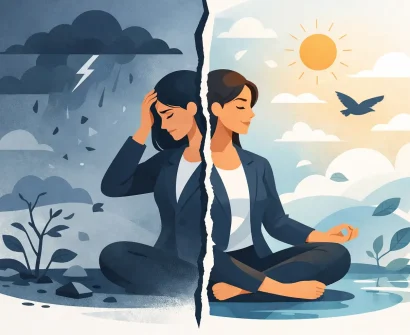




The best ways to restore inner security from its roots
You might end your day surrounded by accomplishments, appearing calm in front of others, only to have that inexplicable anxiety awaken within you. Perhaps a simple message will cause you distress, or you'll feel compelled to monitor everything to prevent any misunderstandings, or you'll withdraw when you need closeness. The search for The best ways to restore internal security It doesn't mean you're weak or that there's something wrong with you. It often means that your nervous system learned at some point that staying alert is the safest way to survive.
Inner security isn't a positive idea you convince yourself of, nor a permanent state of tranquility. It's a tangible feeling that you can face your emotions without collapsing, be close to others without losing yourself, and make mistakes without letting them become a harsh judgment on your worth. This feeling isn't built by force, but by a sincere and gradual relationship with what's happening within you.
Why does security disappear even though your life seems stable?
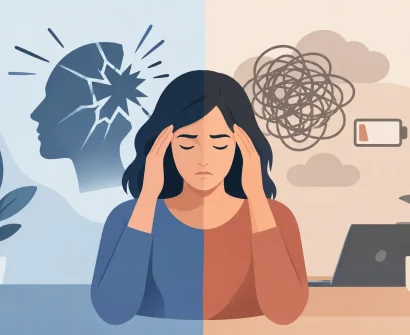
The mind may know you're safe, but the body isn't always convinced. When a person experiences constant criticism, emotional neglect, loss, Clear shocks Or, under prolonged and relentless stress, his nervous system may learn that danger is ever-present, even in ordinary moments. This is when responses such as fight-or-flight, freezing, or appeasement emerge.
The fight-or-flight response might manifest as a quick temper or heightened defensiveness. The escape response might appear as overworking, distraction, or ending relationships before they become deep. The freeze response might feel like an inability to make decisions, emotional numbness, or a feeling of being physically present but emotionally absent. And pleasing others might make you outwardly popular, but it leaves you exhausted because you never know where their needs end and yours begin.
These aren't fixed personality traits. They're intelligent, albeit costly, attempts by your body to protect you. The first step to recovery is to stop fighting these responses as if they were an enemy, and ask them: What are you trying to protect me from?
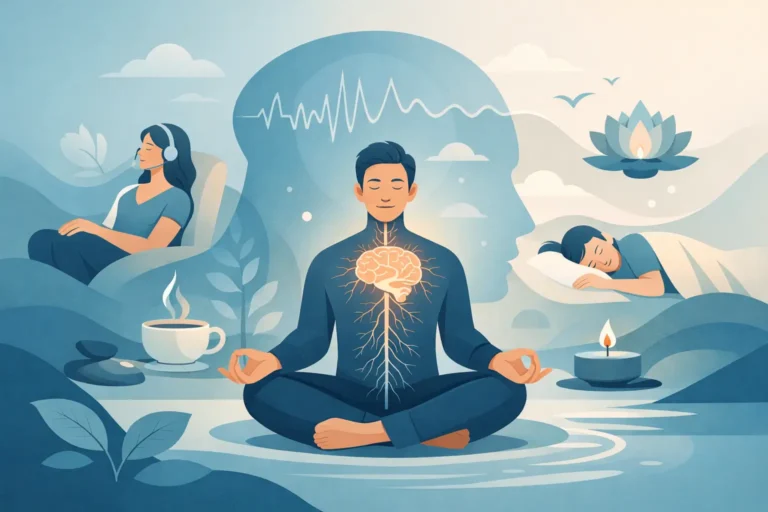
The best ways to restore inner security begin with the body.
When anxiety is high, it's not enough to tell yourself, "There's nothing to be afraid of." Because fear at that moment isn't just a thought; it's a physical state. Your heart might race, your breathing might become labored, your shoulders might tense, or you might feel the need for an immediate decision to find relief.
Before analyzing, return to sensation. Notice your feet on the floor, lean back in your chair, and look calmly around you, allowing your eyes to take in the details of your surroundings. Don't do this as a test you must pass, but as a simple message to your body: I am here now. I am observing my surroundings. There is nothing I need to solve right now.
It might also help that Prolong the exhalation slightly Without forcing yourself, place one hand on your chest and the other on your stomach. If focusing on your breathing increases your anxiety, let go and choose a gentle movement: a slow walk, a stretch, or a light arm shake. What works for one person may not work for another. The goal is not to force yourself to calm down, but to expand your capacity to remain with the experience without being overwhelmed.
Pay attention to gradual progression, not intensity.
Some people try to confront all their pain at once, believing that courage means diving headlong into memories. But security grows in doses that the nervous system can absorb. If you feel yourself approaching panic, detachment, or a loss of control, it's not a sign of failure. It's a sign that your pace needs adjusting.
Gradual progression might mean approaching a difficult feeling for 20 seconds, then returning to something that provides stability: the feel of a blanket, a familiar sound, an open window, or the memory of someone you felt accepted with. This movement between challenge and comfort helps the body learn a new reality: I can feel, and I can return.
Separate the voice of fear from the voice of truth.
Much anxiety comes in a very convincing voice: «If you refuse this request, they’ll leave you,» «If you’re not perfect, you’ll fail,» «Don’t trust anyone,» «Don’t talk about your needs.» Instead of engaging in a long argument with this voice, try naming it. Say: There’s a part of me that’s afraid of rejection. There’s a part that wants to protect me from embarrassment.
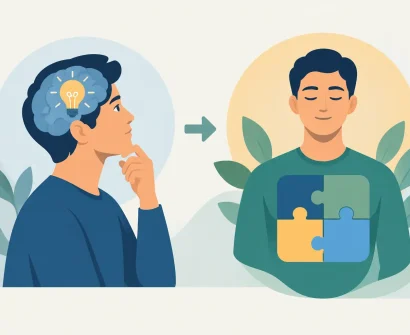
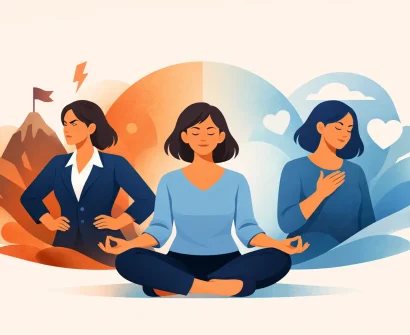
This language isn't sugarcoating the problem. It creates a healthy distance between you and the idea. You are not your anxiety, nor are you the part of yourself that rushes to please everyone or withdraws when it hurts. You have parts that hold stories, fears, and needs, and there's also a calmer capacity for listening and choosing.
The approach to working with parts of yourself, as demonstrated in Inner Family System (IFS) therapy, doesn't ask you to expel the angry or anxious part. Instead, it invites you to understand its role, respect its protective intentions, and then build a more compassionate and clear inner leadership. When fear is no longer the sole manager of your life, you can make decisions from a broader perspective.
Build boundaries that give you comfort, not isolation.
You can't regain inner peace while constantly saying "yes" to what exhausts you. Boundaries aren't a punishment for others, nor are they a withdrawal from love. They're an honest way to protect the space you need to stay connected to yourself.
Start small and manageable. Perhaps you'll postpone replying to a message until you've calmed down, or say, "I need time to think," or decline a commitment you don't have the energy for. You'll sometimes feel guilty, especially if you're used to tying your worth to the approval of others. But guilt doesn't necessarily mean you've done something wrong. Sometimes it's just an old feeling that surfaces when you do something new and healthy.
Conversely, don't let boundaries become a wall that prevents every relationship. Security doesn't grow in complete isolation. It also grows when you experience a relationship where you can be honest and communication remains possible. Choose someone who is relatively mature, share an appropriate amount of your truth, and then observe how you feel afterward. Trust isn't a leap, but rather a series of small, consistent experiences.
Change your relationship with internal criticism
The hardest place to live might be your own inner dialogue. The voice that tells you you're behind, too sensitive, or incapable of fixing your life probably didn't start with you. It might have been an echo of an environment where mistakes weren't safe, or where love was conditional on performance and achievement.
Self-compassion doesn't mean absolving yourself of responsibility. It means holding yourself accountable without self-deprecation, and seeing the behavior clearly without reducing your humanity to it. Instead of saying, "I'm a failure because I withdrew," say, "I withdrew because I felt deeply threatened. What did that part of me need? And what smaller step can I take next?"«
This shift in language is not simple. It reshapes the internal climate you live in every day. And when your inner voice becomes safer, you have less need to run away from your feelings or constantly prove your worth.
When do you need expert support?
Self-care can be helpful, but it's not a substitute for professional support when symptoms are severe or frequent. If intrusive memories, persistently disturbed sleep, anxiety attacks affecting your work and relationships, or thoughts of self-harm are plaguing you, seeking help is a protective step, not a sign of helplessness. In urgent situations or when there is immediate danger, contact emergency services or a trusted person nearby immediately.
Trauma-conscious work doesn't just focus on recounting what happened, but on how it's carried within the body, relationships, and meaning. Appropriate space might involve a compassionate exploration of the roots, the regulation of the nervous system, and an understanding of patterns that are unconsciously repeated. Techniques such as Compassionate InquiryTension and shock release exercises such as TRE®, IFS, and NARM® can be beneficial when used with appropriate training and at a pace that respects your endurance.
You don't need to prove that your pain is "enough" to deserve support. What matters is its impact on you now, and your genuine desire not to spend the rest of your life in survival mode.
Inner peace doesn't arrive as a grand, life-changing event overnight. It might begin with a moment of recognizing your anxiety instead of blaming yourself for it, with a quiet word you say, or with a breath that gives your body a chance to recover. Every time you choose to listen instead of running away, you remind yourself of a truth you deserve: you can be with yourself, and you won't leave yourself alone.