



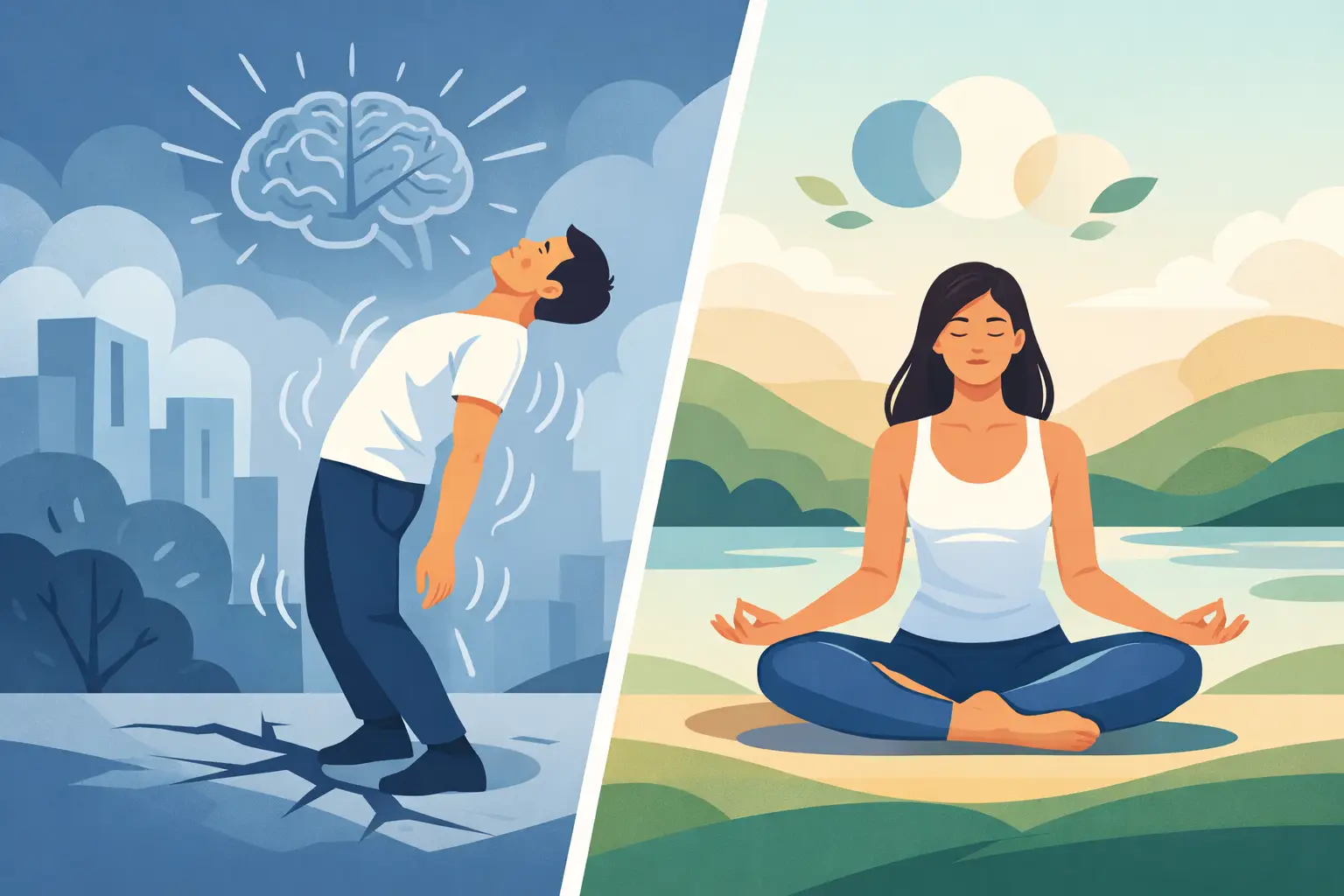
TRE or meditation to relieve stress: Which is right for you?
The comparison between TRE or meditation for stress relief Simple: physical exercise versus quiet sitting. But when stress is building up in your body, waking you up at night, or making you irritable despite your apparent success, the real question isn't: Which is better? Rather: What does your nervous system need right now to feel safe?
Many people try to find a way out of anxiety. They read, analyze, pray, meditate, and make new plans. Yet their chests remain tight, their jaws clenched, and their sleep is light, as if their bodies haven't received the message that the danger has passed. Here, understanding the difference between TRE and meditation becomes a practical step toward a more genuine relationship with yourself, not just adding a new technique to your to-do list.
What does stress do internally?
Stress isn't always a nagging thought that disappears when you convince yourself to calm down. Sometimes it's a clever physiological response your nervous system has learned in times when stress, fear, or insecurity has become overwhelming. This can manifest as persistent anxiety, indecisiveness, an intense need for control, quick temper, or a vague feeling of detachment from yourself and your loved ones.
In these cases, forcing yourself to relax is not the goal. A body accustomed to caution may interpret relaxation itself as a threat. Therefore, deep recovery begins with respecting the signals rather than silencing them, and with gradual progress rather than forced action.
What is TRE?
TRE® stands for Tension and Shock Release Exercises. It is a set of gentle movements that aim to activate a natural muscle twitch in the body, especially around the legs and pelvis, so that the nervous system can gradually release some of the accumulated charge.
The trembling here is not a sign of weakness or loss of control. Our bodies recognize this pattern instinctively. You might see an animal tremble after surviving a threat and then resume its activity. We, however, often suppress this response because we have learned to always be composed, or because we lack a safe space where we can truly feel what is happening.
This doesn't mean that TRE is a magic cure or that it works for everyone in the same way. Some people feel relaxed, warm, and breathe more deeply after the practice, while others may touch on repressed emotions, memories, or a strong sense of vulnerability. This is why mindful accompaniment is especially valuable when you have a history of trauma, panic attacks, dissociation, or difficulty regulating emotions.
When might TRE be appropriate?
You might find TRE a helpful entry point if you're saying, "I understand my problem, but my body won't calm down." If the tension is showing in your shoulders, stomach, and jaw, or if you feel like you're carrying a burden you can't put into words, the practice might give you a more direct understanding of body language.
It may also benefit those prone to overthinking. Not that overthinking is inherently bad, but because some wounds simply don't heal. Sometimes, the body needs to experience, in small doses, that it can feel and then return to a state of well-being.
What does meditation actually offer?
Meditation is not simply emptying the mind. In its mature form, it is a practice of presence: observing your breath, thoughts, and feelings without being consumed by them or fighting them. Over time, it can widen the distance between stimulus and reaction, allowing you to pause before you explode, withdraw, or blame yourself.
Meditation is especially helpful when your mind is scattered, or when you need to develop a clearer awareness of your inner patterns. It might reveal, for example, that your anxiety isn't a true reflection of the future, but rather an age-old attempt to protect yourself from disappointment, rejection, or loss of control. This insight is valuable because it restores your sense of choice.
But meditation isn't always neutral for those experiencing deep tension. Sitting in silence with your eyes closed might be relaxing for one person, but extremely upsetting for another. As distractions subside, feelings, images, or sensations you weren't prepared to encounter on your own may surface. So, if meditation makes you feel more anxious, dizzy, or detached, don't interpret it as a failure on your part. Perhaps your nervous system needs a more gradual and nuanced approach.
When is meditation the best option?
Meditation may be appropriate if you are generally able to stay in touch with your body without being overwhelmed by emotions, and if your goal is to cultivate self-awareness, mindfulness, and compassion. It is also beneficial as a short daily practice that promotes stability, rather than as a harsh test of your ability to cope with pain.
Begin with a few minutes with your eyes open, if that feels safer. Notice your feet on the ground, the sounds around you, and your breath as it is. Don't try to produce a state of spirituality or perfect tranquility. Genuine presence is more important than a calm performance.
TRE or meditation for stress relief: The difference that matters
The fundamental difference is not simply that one is physical and the other mental. TRE often begins from the bottom up: from sensation, movement, and physical energy towards meaning. Meditation, on the other hand, begins with observation and attention, and through this, may lead to calming the body and understanding the experience.
If your body is in a chronic state of alertness, it may be difficult to immediately ask your mind to sit still. And if you are very immersed in physical sensations or easily overwhelmed, beginning with a short, grounding meditation or a supportive conversation may be more appropriate than triggering a physical twitch.
Therefore, there is no single answer that works for everyone. The choice also varies depending on the day and your mood. On a day when you feel sluggish, you might need gentle movement and physical presence. On a day when you are charged and fast-paced, you might need to focus your attention on your surroundings and your breath before any deeper practice.
Don't turn the practice into new pressure
It's easy to turn healing tools into just another achievement project: twenty minutes of meditation daily, relaxation exercises, a gratitude journal, and constant monitoring of every reaction. But the nervous system doesn't heal under threat, even if that threat is your own rigid self-checklist.
The most helpful thing is to treat the practice as a small experiment: What happened before it? How did you feel during it? Did you end up more grounded and present, or more distracted and agitated? You don't need a perfect answer, just genuine curiosity.
After TRE or meditation, give yourself a few minutes to reflect. Drink water, take a slow walk, look around, or write a single sentence about what you noticed. Don't immediately reach for your phone or engage in a stressful conversation. The process of unwinding needs time to transform into a more organized state, not a new surge of energy.
When do you need expert support?
If, during practice, you experience intense painful memories, a feeling of losing track of time, panic, extreme numbness, or thoughts of self-harm, stop and seek appropriate professional support. Similarly, individuals with a complex history of trauma, abuse, or severe mental health disorders often benefit from learning these tools with a qualified and trauma-sensitive practitioner, rather than applying them alone and intensively.
Support is not proof that you are incapable. Rather, it is a way to teach your nervous system a new truth: that you don't have to face your pain alone. In mindful therapy, we don't chase memories or force catharsis. We build internal resources, expand resilience, and always return to the present.
You may not need to choose TRE or meditation as competing paths. You may need to gently ask yourself: Today, do I need to observe? Or to move? Or to find a safe space to listen to what my body is trying to tell me? These quiet questions could be the beginning of a true return to yourself.




Does trauma cause persistent insomnia? And how does relief begin? – montasirmusa.com
[…] Methods that respect rhythm and boundaries, such as compassionate inquiry, TRE® stress and trauma release exercises, working with internal parts in IFS, or NARM® approaches […]